

Temple of Liberty: Building the Capitol for a New Nation
Freedom Triumphant in War and Peace: The Capitol Extended

By the close of the Civil War in 1865 the Capitol had been transformed from a sedate and self-contained building on a rather small scale to an exuberant and complex one of much greater size. Its breadth extended 751 feet across the brow of Capitol Hill and the feather-crested helmet of its corning statue, Freedom Triumphant in War and Peace, rose 287 feet, 5 and 1/2 inches above ground level.
Philadelphia architect Thomas U. Walter had won the competition in 1851 for the Capitol's extension. He and others presented designs based on three possibilities: making a square Capitol by building an addition on the east, placing new wings directly against the north and south walls, or attaching lateral wings to the old building via corridors. The latter, sanctioned by the Senate Committee on Public Buildings, maintained much of the original Capitol integrity.
The new rectangular chambers were placed in the center of each wing at the suggestion of Captain Montgomery C. Meigs (1816-1892) of the Army Corps of Engineers. In 1853 Meigs was put in charge of operations. Until 1859 he chose the painters and sculptors who decorated the Capitol Extension, suggesting themes to them that expressed Euro-American dominance of the continent. Italian-born fresco painter Constantino Brumidi (1805-1880) spent twenty-five years decorating walls and ceilings of committee rooms, offices, and corridors, as well as the rotunda's frieze and canopy painting. His subjects ranged from a visual dictionary of American flora and fauna to American history primarily told through classical allegories.

Portrait of the Architect of the Capitol Extension
Matthew Brady. "Thomas U. Walter". Copyprint from glass negative. Prints and Photographs Division, Library of Congress (181)

Original Capitol as "Improved" and Extended Eastward
Thomas U. Walter. "Perspective View of a Plan for Enlarging the U.S. Capitol,". 1850. Water color on paper. Architect of the Capitol (182)

New House and Senate Chambers Located in Proposed Eastern Extension
Thomas U. Walter. "Plan of Principal Story. Design for an Enlargement of the U.S. Capitol, Washington, D.C.". 1850. Water color on paper. Architect of the Capitol (183)

Proposed Lateral Wings Attached Directly to Original Building
Thomas U. Walter. [Design for the Extension of the Capitol], 1851. Water color on paper. The Athenaeum of Philadelphia (184)
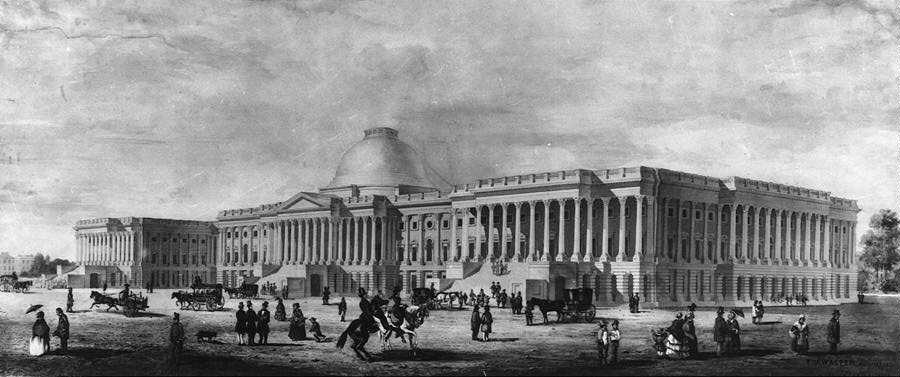
Proposal to Orient New Wings toward Mall
Thomas U. Walter. "Design for an Extension of the U.S. Capitol. Washington, D.C.," 1851. Water color on paper. Architect of the Capitol (185)

Olmsted's Landscape Plan for Capitol Extension
Frederick Law Olmsted. "General Plan for the Improvement of the U.S. Capitol Grounds,". 1874. Ink and water color on paper. Architect of the Capitol (187)

Walter's Senate Chamber Located on Capitol's Northwest Corner
Thomas U. Walter. "Plan of Principal Story, North Wing,". 1856. Ink and water color on paper. Architect of the Capitol (188)

Pediments with Sculpture Added to East Porticoes
Thomas U. Walter and Montgomery Meigs. "Eastern Elevation of North Wing. Capitol Extension,". 1853. Ink and water color on paper. Architect of the Capitol (189)
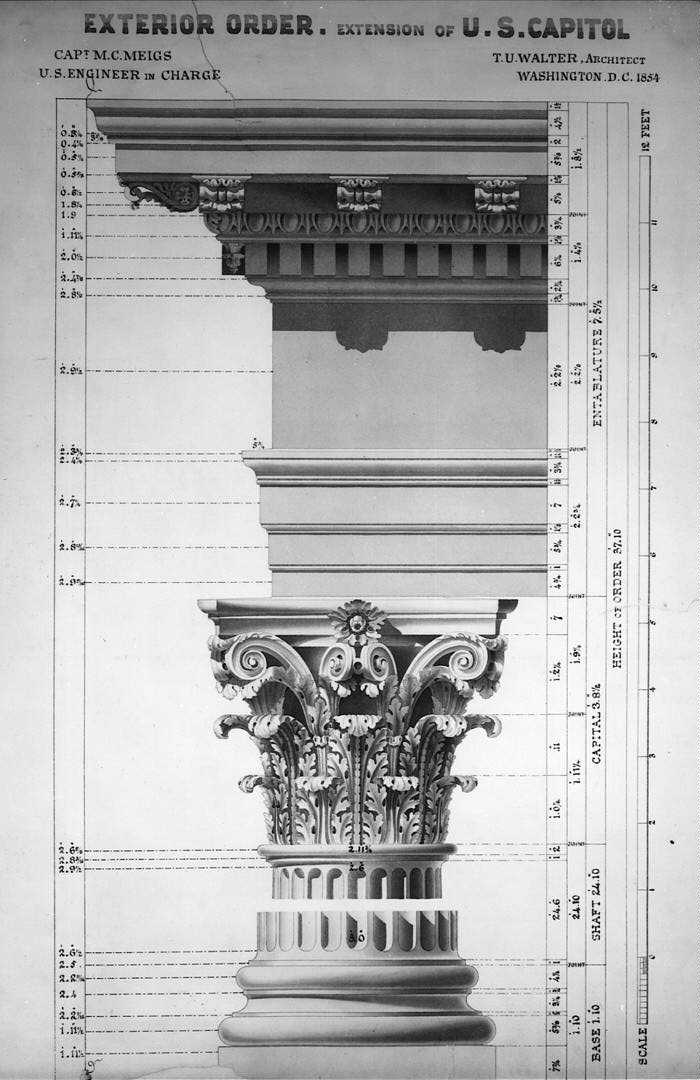
Thornton's Original Corinthian Order Copied by Walter
Thomas U. Walter. "Exterior Order. Extension of U.S. Capitol,". 1854. Ink and water color on paper. Architect of the Capitol (190)
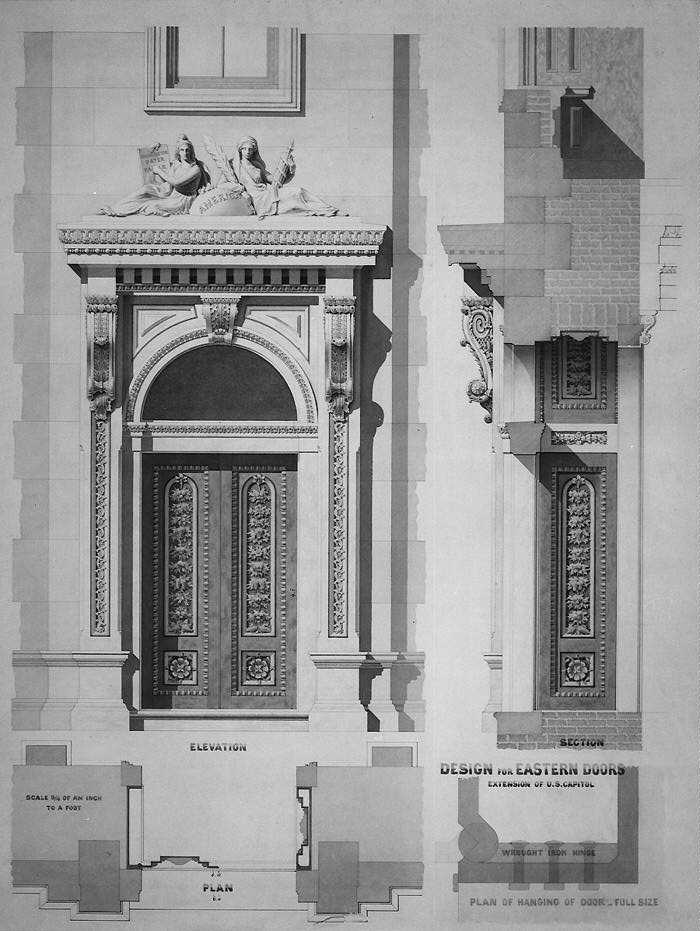
Decoration Interlocks with Structure
Thomas U. Walter. "Design for Eastern Doors. Extension of U.S, Capitol," c. 1863. Ink and water-color on paper. Architect of the Capitol (191)

Washington's Civic and Military Deeds Recalled
Thomas U. Walter. "Front Door, U.S. Capitol" c. 1853-1857. Ink and water-color on paper. Architect of the Capitol (192)

Senate Chamber Moved to Center of Wing
Thomas U. Walter and Montgomery Meigs. "Plan of Principal Story, North Wing," c. 1856. Ink and ink washes on paper. Architect of the Capitol (193)
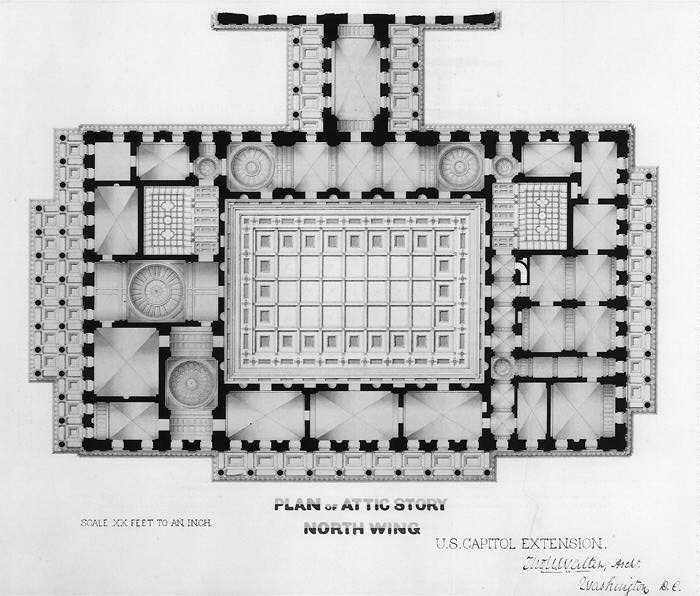
Flat Glass Ceiling Covers Senate Chamber
Thomas U. Walter. "Plan of Attic Story, North Wing, U.S. Capitol Extension," c. 1853. Ink and water-color on paper. Architect of the Capitol (194)
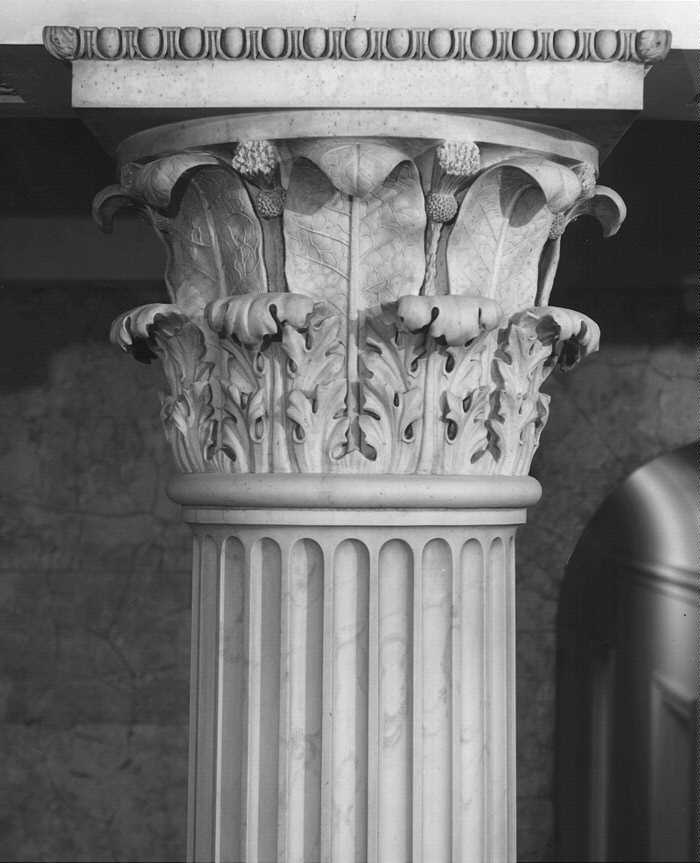
Walter's Second American Order
Thomas U. Walter. [American Order in Senate Vestibule], 1858. Copyprint. Architect of the Capitol (196)

Photograph of Lost Drawing of Vice President's Room Ceiling
Constantino Brumidi. [Ceiling of the Vice President's Room, North Wing], c. 1856. Copyprint. Prints and Photographs Division, Library of Congress (200)

Italian Renaissance Model for Ceiling of Vice President's Room
"Coved Ceiling of the 'Stanza Della Segnatura' in the Vatican by Raphalle D'Urbino". Lewis Gruner, Specimens of Ornamental Art. London: Thomas McLean, 1850, p. 80. Color engraving in book. General Collections. Library of Congress (201)

Large Public Galleries in New Legislative Chambers
Thomas U. Walter. "Details of Gallery in Hall of Representatives," 1856. Ink and water color on paper. Architect of the Capitol (204)

Passing of an Era Commemorated in House of Representatives Clock
William Henry Rinehart. "Design for Clock for Hall of Representatives," 1858. Photo, ink, and water color on paper. Architect of the Capitol (205)

State Seals Painted on Glass Decorated House Ceiling
Johannes A. Oertel. [Delaware State Seal from the House of Representatives Chamber Ceiling,] c. 1856. Oil on glass. Delaware State Museums, Dover (206)

Walter's Cast-Iron Dome Overwhelms Original Building
Thomas U. Walter. "Elevation of Dome of U.S. Capitol," 1859. Ink and water color on paper. Bequeathed to the Library of Congress by Ida Walter, 1915 (207)

Russian Model for Capitol's Dome
Ricard de Montferrand. [Dome of St. Isaac's Cathedral, St. Petersburg, 1818-1858]. Copyprint of architectural drawing. Architect of the Capitol (208)

Dome's Cast Iron is Both Decoration and Structure
Thomas U. Walter. "Section through Dome of U.S. Capitol," 1859. Ink and water color on paper. Bequeathed to the Library of Congress by Ida Walter, 1915 (209)

Figure of Freedom With Liberty Cap
Thomas Crawford. [Second Design of Freedom Triumphant in War and Peace ,] 1855. Copyprint. Architect of the Capitol (210)

Commemorative Statuette
Combines Elements of Crawford's Three Designs of Freedom. Unknown maker after Thomas Crawford. [Figure of Freedom Triumphant in War and Peace,] c. 1855. Sculpture, zinc with nickel-plated stars. Courtesy of Mr. and Mrs. Set Charles Momjian (211)

Capitol Frieze Done in Monochromatic Painting to Imitate Sculpture
Constantino Brumidi. "Peace Between General Oglethorpe and the Indians, 1732," c. 1859. Oil wash on kraft paper. Architect of the Capitol (214)

"The Battle of Lexington, 1775" and "The Declaration of Independence, 1776,"
c. 1859. Constantino Brumidi. Oil wash on kraft paper. Architect of the Capitol (215)

"Discovery of Gold in California, 1848," ca. 1859
Constantino Brumidi. Oil wash on kraft paper. Architect of the Capitol (216)

Early Design of Dome's Canopy Painting Has Founding Fathers in Contemporary Dress
Constantino Brumidi. The Apotheosis of George Washington, c. 1859-1862. Oil on canvas. The Athenaeum of Philadelphia (217)

Canopy Painting's Final Design Focuses on American Achievements
"Brumidi's Allegorical Painting" c. 1865. Constantino Brumidi. Color lithograph. Prints and Photographs Division, Library of Congress (218)

Euro-American Dominance of North American Continent Celebrated in Senate Pediment
Thomas Crawford. Progress of Civilization, c. 1853. [Preliminary Sketch for Model of East Pediment of North Wing, U.-S. Capitol]. Ink and ink washes on paper. Architect of the Capitol (219)

"Genius" Represents the Spirit of the People in House Pediment
Paul Bartlett. Head of "Genius," from Peace Protecting Genius, [central group, South Wing Pediment] 1911-1913. Plaster. Tudor Place Foundation, Inc., Washington (222)


