

Temple of Liberty: Building the Capitol for a New Nation
The Temple of Justice and Faith: The Capitol's East and West Porticoes and Dome

In 1791 Pierrre Charles L'Enfant had located his "Congress House" atop Jenkins Hill, which he said "stands as a pedestal waiting for a monument." He proposed for it a domed rotunda facing west. Subsequent architects designed domes to identify the Capitol on the city's skyline. Impressive central porticoes facing east and west transcended entry points. Rather they drew visitors to the rotunda, perceived from the beginning as a great public meeting place, first a monument to Washington, but soon a "Hall of the People," a usage probably proposed by Jefferson. The entire ensemble of dome, rotunda, and porticoes occupied fully one-third of the original Capitol mass. These symbolic areas were balanced by actual functional spaces, the chambers, committee rooms, and offices in the wings. The general outline of the Capitol's compact and coherent exterior was established in 1793. Minor changes were confined to the central section, not constructed until 1818-1826.

Capitol as It Was Envisioned About 1797
Architectural Model of Thornton's Revised Design of the Capitol. Plastic Model, 1994. Architect of the Capitol (74)
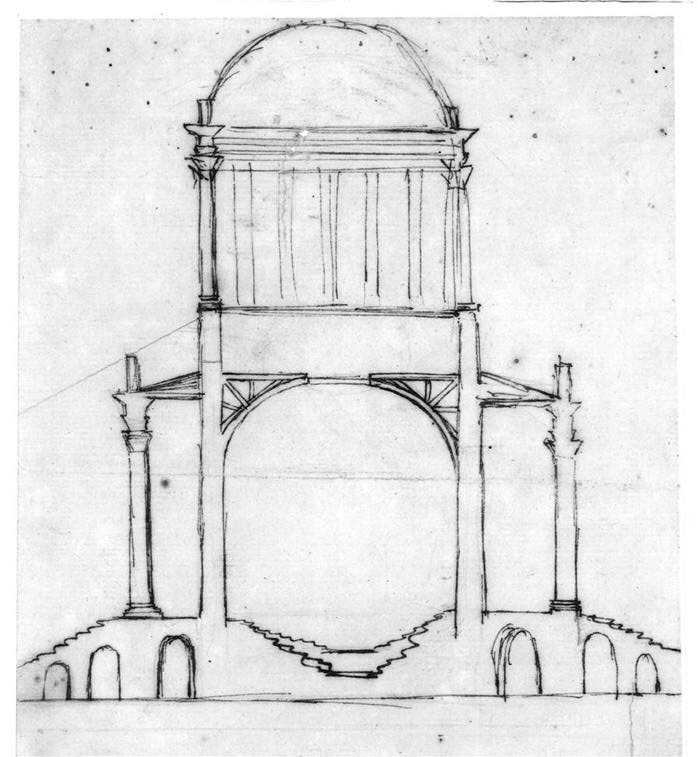
Thornton Sketches Free-Standing Temple Design
William Thornton. [Sketch of Section of Monument and Conference Room], c. 1797. Ink on paper Prints and Photographs Division, Library of Congress (75)
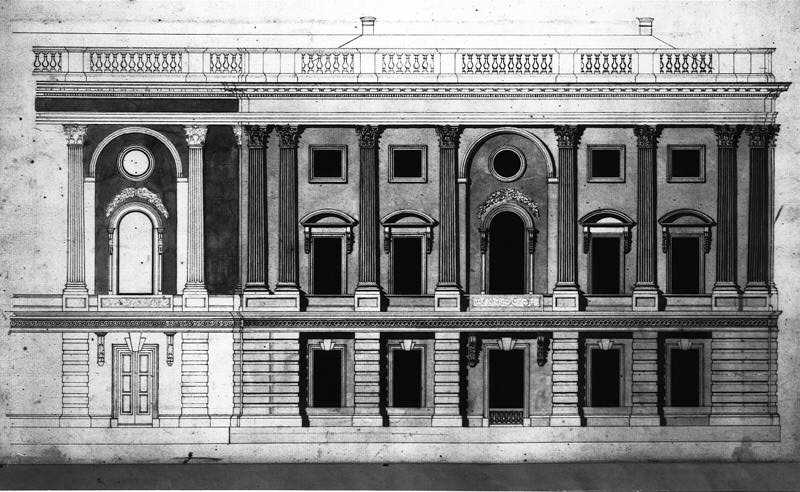
Wall Pattern for Wings Never Changed
William Thornton. [East Elevation for North Wing], 1795-1797. Water color on paper. Prints and Photographs Division, Library of Congress (76)

Elaborate Corinthian Order Expresses Capitol's Importance
William Thornton/Charles Bulfinch. Corinthian Capital from East Front Portico of the Capitol, 1825. Copyprint of Aquia sandstone sculpture. Architect of the Capitol (77)

English Architect Hired to Execute Capitol Suggests Changes
Attributed to Alexander Jackson Davis, after George Hadfield. "Plan for the Capitol, Washington, by George Hadfield, first Arc. 1795," c. 1831-1834. Water color on paper. Machen Collection. The Historical Society of Washington, D.C. (79)

East Elevation of the Capitol

West Elevation of the Capitol
Simplification of Capitol Design Suggested. Attributed to George Hadfield. [East and West Elevations of the Capitol], c. 1795. Ink on paper. Maryland Historical Society, Baltimore (81a, 81b)

Capitol as It Might Have Appeared in 1804
William C. Allen. [Conjectural Reconstruction of House of Representatives of 1804], 1989. Copyprint. Architect of the Capitol (82)

Capitol's Minor Rooms in Evolution
William Thornton. [Plan of Ground Story of the Capitol,] c. 1795-1797. Ink and water color on paper. Prints and Photographs Division, Library of Congress (85)

Thornton Plans Alternate Conference Room Design
William Thornton. [Plan of the Principal Floor of the Capitol], c. 1793-1797. Ink and water color on paper. Prints and Photographs Division, Library of Congress (86)

Jefferson Used Ancient Prototype for Capitol's New East Portico
Robert Wood. "Temple [of the Sun]," in The Ruins of Palmyra, Otherwise Tedmor in the Desart [sic]. London: 1753, Table XIV. Engraving in book. Rare Book and Special Collections Division, Library of Congress (88.1)

Latrobe Plans Dome with Hidden Light Source and Recessed West Portico
Benjamin Henry Latrobe. [Study for a West Front], c. 1808-1809. Water color on paper. Prints and Photographs Division, Library of Congress (89)

Latrobe Plans Relief Sculpture for Drum of Dome
Benjamin Henry Latrobe. [Perspective View of the Capitol from the Northeast], 1810. Water color on paper. Maryland Historical Society, Baltimore (90)

Capitol First Considered in Relation to Its Grounds
Benjamin Henry Latrobe. [Plan of the Mall and the Capitol Grounds], 1815. Water color on paper. Geography and Map Division, Library of Congress (92)

Capitol as Redesigned by Latrobe about 1811
Architectural Model of Benjamin Henry Latrobe's Design for the Capitol, c. 1811. Plastic model, 1994. Architect of the Capitol (93)

Giant Statue of Liberty Proposed for Capitol's East Front
Benjamin Henry Latrobe. [Figure of Athena or Minerva as American Liberty], c. 1811. Water color on paper. Prints and Photographs Division, Library of Congress (96)

Capitol and Other Public Buildings Burnt by British on August 24, 1814
Charles Turner after John James Hall. "Admiral Sir John Cockburn," 1819. Engraving. Prints and Photographs Division, Library of Congress (97)

Bulfinch Adds Subbasement for Additional Offices
Charles Bulfinch. [Sketch of West Front of the Capitol in Letter to John Trumbull], April 17, 1818. Pencil on paper. John Trumbull Papers. Manuscript Division, Library of Congress (100)

First Publication of Capitol with Bulfinch's New West Front Design
W.I. Stone. "Correct Map of the City of Washington," 1820. Engraved Map. Geography and Map Division, Library of Congress (101)

English Architect Copies Bulfinch's East Elevation
Charles A. Busby. "The Capitol at Washington. Elevation of the Principal Front," 1823. Etching on paper. Prints and Photographs Division, Library of Congress (102)

Hemispherical and Stilted-Arch Domes Compared
Charles Bulfinch. [Alternate designs for the U.S. Capitol Dome], c. 1824. Ink. Prints and Photographs Division, Library of Congress (103)

Early Perspective Drawing of Completed Capitol
Attributed to George Strickland. [Perspective drawing of the Capitol from the Northeast,] c. 1830-1840. Ink on paper. Architect of the Capitol (104)

Only Known Photograph of West Front Before Extension
Unknown Photographer. [West Front of Capitol,] c. 1848. Copyprint. Architect of the Capitol (105)
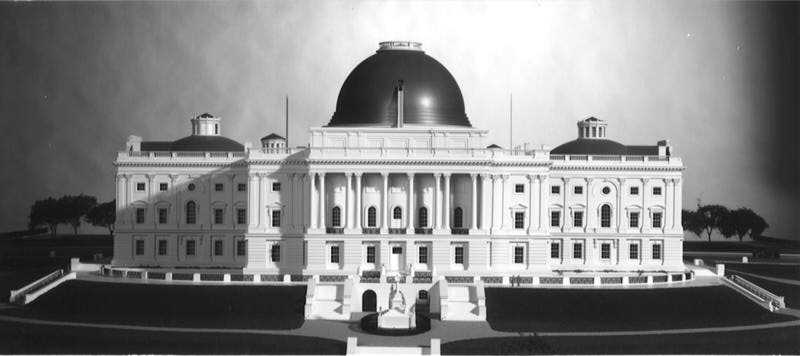
Capitol as Completed in 1826
Architectural Model of Charles Bulfinch's Capitol. Plastic model, 1994. Architect of the Capitol (106)

West Terrace Continues Ground Level of East Side
Charles Bulfinch. [Site Plan of the Capitol], c. 1826-29. Water color on paper. Prints and Photographs Division, Library of Congress (107)

Bulfinch Gatehouses and West Entry
John Rubens Smith. [West Front of the Capitol with Gatehouses], c. 1828. Water color on paper. John Rubens Smith Collection. Gift of the Madison Council and Mrs. Joseph Carson. Prints and Photographs Division, Library of Congress (108)
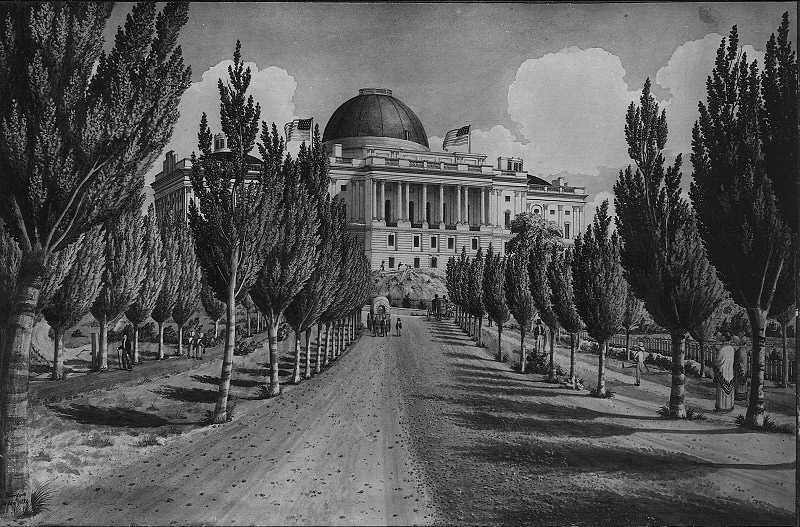
Watercolor Presented to Marquis de Lafayette
Watercolor Presented to Marquis de Lafayette to Commemorate His 1824 Visit to Capitol Charles Burton. "West Front of the Capitol of the United States," 1824. Water color on paper. Lent by the Metropolitan Museum of Art. Purchase, Joseph Pulitzer Bequest, 1942 (109)

Comparison Between Temple of Liberty and Nearby Log Cabins
John Rubens Smith. [West Front of the Capitol], c. 1828. Pencil on paper. John Rubens Smith Collection. Gift of the Madison Council and Mrs. Joseph Carson. Prints and Photographs Division, Library of Congress (110)

Capitol Overlooks Pastoral Landscape
Russell Smith. "Capitol from Mr. Elliot's Garden," c. 1839. Oil on paper. Architect of the Capitol (113)

Only Known Photograph of Capitol's East Front Before Extension
John Plumbe. [East Front of the Capitol], 1846. Copyprint from glass negative. Prints and Photographs Division, Library of Congress (114)

John Quincy Adams Advises on Capitol Sculpture
Luigi Persico. Genius of America, 1825-1828. Copyprint of sculpture. Architect of the Capitol (115)

War as Classical Figure of Mars
Luigi Persico. War, 1834. Copyprint of sculpture. Architect of the Capitol (116)

Peace Personified as Ceres, Classical Goddess of Agriculture
Luigi Persico Peace, 1834 Copyprint of sculpture Architect of the Capitol (117)


